Comprehensive Analysis on Whether Was the Inca Empire Polytheistic or Monotheistic
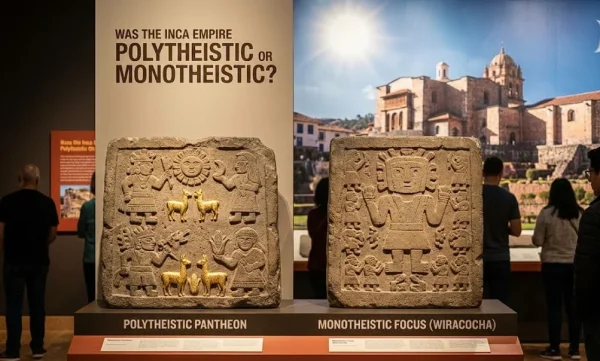
To answer the historical question was the Inca Empire polytheistic or monotheistic, scholars confirm that the civilization practiced a polytheistic system, worshipping a vast pantheon of nature deities. While some early chroniclers tried to draw parallels to Christianity, framing the Inca Empire monotheistic religion or polytheistic religion debate around the creator god Viracocha, the evidence clearly shows they honored multiple gods simultaneously.
Therefore, when defining what type of religion did the Inca Empire have, it is best classified as "Solar Polytheism" or Henotheism, where the Sun (Inti) was the supreme deity of the state, but he existed alongside the Moon, Stars, Thunder, and Earth, without denying their divine power.
Defining the Characteristics of Religion of the Inca Empire and Its Deities
The primary characteristics of religion of the Inca Empire were its intense connection to the landscape (sacred geography) and its rigid hierarchy which mirrored the empire’s political administration. When identifying what was the religion of the Inca Empire, we find a pantheon led by Viracocha (the abstract Creator), Inti (the Sun and father of the Inca), and Pachamama (Mother Earth), who governed agricultural fertility.
The ancient Inca Empire religion was transactional and reciprocal; humans provided offerings (Despachos) and sacrifices, and in return, the deities provided rain, sunshine, and protection, creating a cycle of mutual obligation known as Ayni.
The Concept of Duality and Inca Empire Religion Beliefs Regarding the Universe
Central to Inca Empire religion beliefs was the concept of Yanantin, or complementary duality, which viewed the universe as a balance of opposing forces (male/female, sun/moon, upper/lower).
Religion in the Inca Empire divided the cosmos into three distinct planes: Hanan Pacha (the World Above), Kay Pacha (This World), and Ukhu Pacha (the Underworld). Understanding what is the religion of the Inca Empire requires grasping this tripartite philosophy, where the Sapa Inca acted as the vital bridge connecting the celestial realm with the earth, ensuring cosmic order through his rituals.
Explain the Role of Religion in the Inca Empire Expansionism and Politics
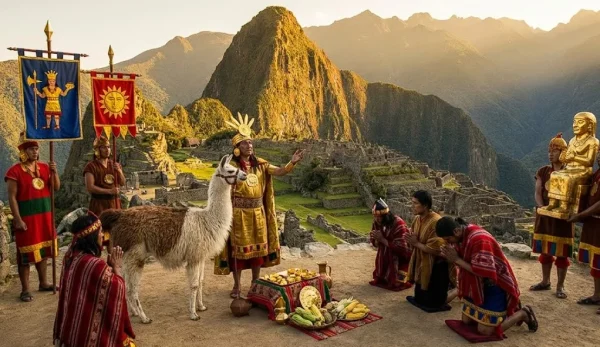
To explain the role of religion in the Inca Empire, one must recognize that spiritual indoctrination was a strategic tool used to consolidate political power over newly acquired territories. In the context of religion and empire the dynamics of Aztec and Inca expansionism, the Incas differed by using religion to integrate rather than just terrorize; they presented the Inca Emperor as the benevolent son of the Sun, making submission to him a spiritual duty.
The Empire Inca religion functioned as an imperial ideology, where the construction of a Sun Temple in a conquered province symbolized the physical and spiritual presence of Cusco, legitimized by divine mandate.
How the Inca Empire Let Conquered People to Practice Their Own Religion
Strategically, the Inca Empire let conquered people to practice their own religion, permitting them to retain their local gods and shrines as long as they accepted the supremacy of Inti, the Sun God. This policy of religious tolerance helped the Inca Empire get conquered people to practice their own religion alongside the state cult, effectively reducing the likelihood of rebellion driven by spiritual suppression.
As a result, Inca Empire religion and culture became a blend of official state theology and local folk traditions, where regional idols were often brought to Cusco’s Coricancha temple, ostensibly as "guests" but effectively as hostages to ensure the loyalty of their devotees.
Historical Debate on Whether the Inca Empire Forced Religion on Conquered People
Despite their tolerance, the Inca Empire forced religion on its subjects in the sense that worship of the Sun and the Emperor was mandatory for all citizens, creating a layer of state obligation above local beliefs. Through a system of Inca Empire reeducation forced religion tactics, the children of provincial chieftains were taken to Cusco to be raised in the imperial court, learning the rites of the Sun to ensure they would govern as culturally Inca leaders.
Thus, the Inca Empire re education forced religion conquered people to align with the central administration’s worldview, ensuring that the "children of the sun" narrative replaced local creation myths over generations.
The Relationship Between Art and Religion in the Inca Empire
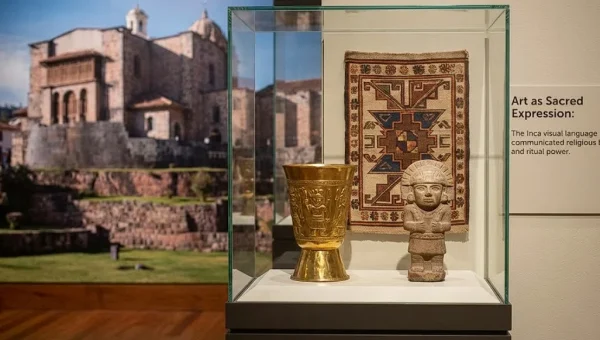
The relationship between art and religion in the Inca Empire was inseparable, as art served as the medium through which the sacred was made visible and tangible. Art and religion in Inca Empire society dictated that precious metals were not currency but divine substances; gold was the "sweat of the sun" and silver the "tears of the moon."
Consequently, art and religion in the Inca Empire resulted in the creation of magnificent temples like the Coricancha, which was literally sheathed in gold plates, transforming architecture into a direct act of worship and a reflection of divine brilliance.
Sacred Objects and Inca Empire Religion Artifacts Used in Ceremonies
Inca Empire religion artifacts were vital tools for mediation between humans and the divine, including the Kero (ceremonial wooden cup) used for ritual toasts of Chicha beer. These Inca Empire religion and gods were also honored through Huacas sacred objects that could be anything from a carved stone amulet (Conopa) to a mummified ancestor (Mallqui).
In the study of Inca Empire religion/ god worship, these artifacts were treated as living entities that had to be fed, clothed, and consulted, serving as the physical vessels for spiritual power during ceremonies.
How Were Animals Used in Religion of the Inca Empire for Sacrifices
To understand how were animals used in religion of the Inca Empire, historical records show that the Llama and the Alpaca were the primary sacrificial offerings used to appease the gods and predict the future.
Inca Empire religion and animals shared a deep bond; priests would sacrifice domesticated camelids daily in Cusco, examining their lungs and hearts to divine the outcome of wars or harvests. White llamas were often dedicated to the Sun, while black llamas were offered to thunder or earth deities, symbolizing the purification of the community through the animal's life force.
Educational Resources on Inca Empire Religion for Kids and Students
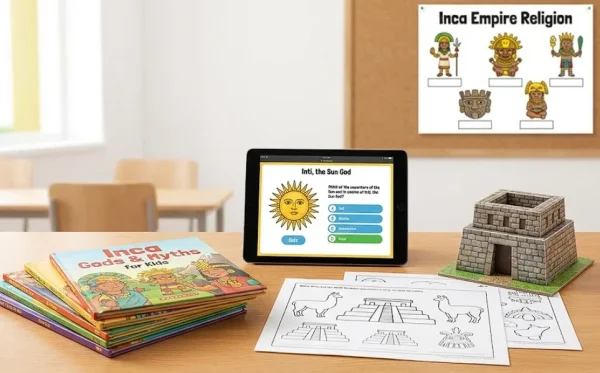
Teaching Inca Empire religion for kids involves simplifying complex cosmologies into engaging narratives about the "Children of the Sun" and their respect for nature. Resources that cover Inca Empire for kids mythology and religion ducksters style often focus on the founding legends of Manco Cápac rising from Lake Titicaca.
When explaining religion children of the sun the Inca Empire for kids, it is effective to highlight the Inti Raymi festival and how the Incas saw shapes in the Milky Way (like the Llama and the Toad), helping young students connect the ancient beliefs with the visible night sky.
Summary of What Religion Did the Inca Empire Practice for School Projects
For students asking what religion did the Inca Empire practice, the most accurate summary is a polytheistic solar religion that incorporated ancestor worship and animism. When researching what religion was the Inca Empire, it is crucial to understand it was a state imposed system designed to unify the Andes under the Sapa Inca.
Although there is no single native Inca Empire religion name, it is academically referred to as the Andean Cosmovision, a belief system where every mountain, river, and stone was imbued with spiritual significance and required respect.
The Connection Between Inca Empire Religion and Education of the Elite
The Inca Empire religion and education were deeply intertwined within the Yachaywasi ("House of Knowledge"), where the male nobility was trained by Amautas (philosopher-scholars). Looking at Inca Empire religion in 1500, the priesthood acted as the guardians of knowledge, teaching astronomy, history, and ritual law to the future administrators of the realm.
To understand what is the religion and culture of Inca Empire, one must see that the elite were educated to read the sky as a calendar, ensuring that religious festivals coincided perfectly with the agricultural seasons that sustained the empire.